
Reframing Stress

Stress can be our worst enemy, at times. Especially, when we are asked to do some public speaking, which is one of the greatest human fears and stressors of all time!
That bloody presentation! (Why did they even ask me?)
The scenario goes like this- you have been asked to co-facilitate a presentation on neurodiversity by your RTLB Cluster Manager and RTLB Practice Leader. They are enthusiastic and believe that you can do an effective job, which is co-facilitating to a range of primary kura staff in the cluster. School leadership, SENCo’s and Learning Support Coordinator’s (LSC’s) will be in attendance, in a month’s time.
You accept on the spot with a fake smile on your face, because you don’t want to let your leadership team down. A collaborative decision is then made that your specific presentation focus will be on masking in the classroom, with regards to autistic ākonga.
Soon after your ‘acceptance speech’, you walk out the door and start to feel imposter syndrome gathering momentum in your brain. You start to think you don’t have the necessary skills or knowledge to facilitate such a presentation. You also think another, more experienced colleague is better suited to the role. You are quick to minimise your experience and expertise, around neurodiversity. “Why me?”, is starting to be a recurring question in your head.
You also start to ask yourself additional questions. It is a classic case of cognitive rumination at play. You know these questions are not helpful, at all:
Am I good enough to do this presentation?
What will the audience think of me?
What if I say the wrong thing and I offend someone in the audience?
What if people start to go on their phone or even worse-leave while I am presenting?!
These intrusive thoughts, in the form of unhelpful questions, occur on a daily basis. You try to stop these irrational questions when they pop up, but you can’t. They are simply too powerful and keep careening though like a run-away freight train.
You stew about the presentation for weeks. The days leading up to the presentation are pure agony for you. The thought of presenting deeply consumes your thoughts and you stop enjoying things that you normally like doing. Going for walks and seeing a movie are things of the past. Even your sleep is impacted. Only four, maybe five hours per night! You are now a dishevelled, tired wreck! Where is the Rescue Remedy? (Luckily, you have some in the cupboard).

It's two hours before the presentation. Dominant physiological reactions reign sub-consciously within your body. This includes an elevated THUMPING heart and raised blood pressure. Shallow deep, rapid breathing and muscle tension occurs at the sub-cortical level. Your body is in homeostatic imbalance where the stress hormone, cortisol, is flowing too freely. Your brain and body are over ridden by a flow of negative energy. Your Pre-frontal Cortex (PVC) starts to go off-line and those insidious thoughts begin again, reverberating in your head. You only half-tune into important work conversations and between hui your favourite podcast doesn’t seem that interesting anymore.
Enough is enough- call time out! You go for a long, brisk walk an hour before the presentation, which helps calm and reset your nervous system. Although you are sweaty with the brisk walk, you start to have clearer thoughts and greater perspective. This resetting of your nervous system will hold you in good stead during the presentation. You are now in your Window of Tolerance. Thank goodness for that. Just in time!
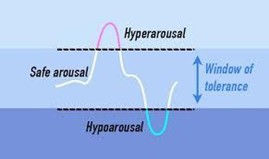
A wonderful thing happens that you did not expect at all! Your presentation goes very well and afterwards you privately berate yourself for stewing on it for weeks. That wasted, negative energy cascading through your brain and body! In fact, soon after the presentation has finished, oxytocin is now replacing cortisol in your body, due to all that positive verbal feedback you are now receiving from educators and colleagues alike. If only they knew the tortuous thought-journey you have been on in recent weeks. Many, many hours of negative rumination. Your ‘bundle of nerves’, have thankfully, subsided. A seismic weight has been lifted from your shoulders. After work, you decide to ring a friend and go to the movies. Joy at last!
Stress-is-Enhancing Mindset
The tortuous thought-journey, highlighted in the fictitious scenario described above inflicts so many people in real-life. It is partly personality driven. Some people are lucky just to have minor presentation jitters, but some people will be significantly impacted- like the scenario described in this blog. However, it DOES NOT need to be such an emotional roller-coaster. I’ll tell you why, right now.
There is an important strategy in psychology, called cognitive reframing. It is a very powerful general strategy that can help you manage your own intrusive thoughts in a positive way. Cognitive reframing is in very simple terms, changing your negative thoughts to positive ones. Cognitive reframing can be applied to perceived stressful events. It is called having a stress-is-enhancing mindset (Crum et al., 2013). This mindset promotes positive challenge and opportunity and Crum et al. (2013) have identified that it can decrease negative anxiety or stress at the physiological level. In addition, people who adopt this mindset are more open to feedback (Crum et al., 2013). In contrast, the stress-is-debilitating mindset is characterised by an individual dwelling on the negative impact of stress to their lives.
Subsequent research by Crum et al., (2017) noted that a stress-is-enhancing mindset can help promote positive emotions and greater cognitive flexibility. Moreover, such a mindset can help reduce challenging and threatening stress.
Several academics have taken the original stress-is-enhancing mindset idea further by combining it with Growth Mindset philosophy, developed by Carol Dweck. Growth Mindset philosophy highlights that intelligence is not fixed, it can be developed by focusing on personal effort, trying new strategies and seeking input from others (Dweck, 2015).
In a study by Yeager et al. (2022), thousands of adolescent participants interacted with an online, synergistic-based module. The collated results identified several improved outcomes for the participants, including a reduction in stress-related cognitions, cardiovascular reactivity, daily cortisol levels, and anxiety symptoms. Conversely, there was a measurable increase in psychological wellbeing and academic success. The researchers coined the term "synergistic mindsets" because they found that an integration of both a growth mindset and a stress-is-enhancing mindset contributed directly to these positive outcomes (p. 512).

Implementing stress-is-Enhancing Mindset: Acknowledge, Welcome, Utilise
There are three-steps that can be implemented, with the stress-is-enhancing mindset. Let’s apply these steps to the above work-based presentation scenario. Firstly, after you have accepted the presentation invite, acknowledge that you are feeling stressed. This is recognising your own physiological signs without any judgement at all. Examples, include:
I have a racing heart.
My breathing is fast and rapid.
I am sweating on my forehead.
My neck feels tight.
Secondly, welcome the stress. Understand that stress occurs because you care about something (i.e. doing the presentation). This is an opportunity to model “stress-is-good” thinking, by improving skills, knowledge and an opportunity to learn. Promotion of improving skills, knowledge and opportunity to learn, is encapsulated in the following two paragraphs:
Although I am feeling stressed to do this presentation, it is a wonderful opportunity. It REALLY is! I am very pleased the leadership has asked me. I will learn more about neurodiversity and masking. By researching this topic, I will increase my professional knowledge. This will add to the knowledge I already have.
I also like putting interesting, effective presentation slides together. Preparing this presentation will help calm my nerves and may provide further presentation opportunities for me. I can also promote this learning in my casework.
The third step is to utilise or transform the energy from your own stress response to tackle the challenge. The ‘challenge’ here is being energetic by preparing a presentation around neurodiversity and masking related to autistic ākonga. Breaking this challenge down into manageable planning steps is important. Marking-off these steps when they are completed is a reassuring, motivating process. In addition being well-prepared will help with the delivery of the presentation. Here are the proposed planning steps:
Locate research focusing on masking in autistic students. Prioritise Aotearoa-based research.
Identify research-based strategies that help when ākonga mask.
Highlight ākonga voice around their masking experiences and what works for them in the classroom/school setting.
Create interactive, effective presentation slides around these topics. Include questions for peer interaction.
Practice presenting each slide.
Benefits for all
Adopting this stress-is-enhancing or synergistic mindset approach can have positive benefits for educators. You, as an RTLB, are in a privileged position to enact such change with educators. If you notice they are stressed with something or someone that links directly to your mahi offer to support them by formulating a stress-is-enhancing mindset. If they say yes to your offer, go through the sequential steps with them- acknowledge, welcome and utilise. Capture their voice at every step, they need to drive the process.
RTLB Practice Leaders can also help enact this mindset change with RTLBs they directly support. Going through the above steps in supervision or coaching settings, can help reframe negative thinking and also help reset casework plans, in a positive manner. Once again, capture RTLB voice- they need to drive the process.
Most importantly, ākonga thinking can directly be reframed using this positive mindset. Working collaboratively with kaiako can enable this to happen. Many scripts (see resources below) can be promoted within Te Tūāpapa: Te Matua, Te Kāhui or Te Arotahi to help ākonga recognise that their stress has meaning and that there is optimism for the future. The focus can be on reframing:
PhysiologicaI sensations
The purpose
Opportunities for growth
Importance of social support
Transition-to-calm

There are so many wonderful opportunities with implementing a stress-is-enhancing mindset. Next time you are asked to do a work presentation, maybe you can positively reframe it so your body stays in homeostasis, most of the time.
An important point to consider is that cognitive reframing can certainly be a helpful strategy, but it firstly needs to be layered with a body-based somatic approach (such as deep-breathing) to firstly calm and regulate the nervous system, so the prefrontal cortex is accessible and ‘on-line’.
If nothing else, remember the following statements when you are reflecting on your own RTLB casework and/or project work, during your own stressful moments. These reminder statements may also be useful to others when they are faced with their own stressors:
Negative thinking begets negative thinking.
However, positive thinking begets positive thinking.


Glossary (Information is AI-generated)
Cognitive Reframing:
It helps individuals identify, challenge, and replace negative or irrational thoughts with more positive, balanced, or constructive perspectives. By shifting the "frame" through which a situation is viewed, it reduces anxiety, improves emotional well-being, and boosts resilience by breaking negative thought patterns.
Cognitive Rumination:
Cognitive rumination is a compulsive, circular pattern of negative thinking where an individual passively dwells on distressing emotions, past mistakes, or future worries. It acts like a "broken record" in the mind, often causing high stress, anxiety, depression, and impaired daily functioning.
Cortisol:
Cortisol, produced by the adrenal glands, is a crucial steroid hormone regulating metabolism, immune response, blood pressure, and sleep-wake cycles. As the primary stress hormone, its levels rise during danger or chronic stress.
Homeostasis/Homeostatic imbalance:
Homeostasis is the self-regulating process by which biological systems maintain a stable internal environment while adjusting to external changes. Derived from the Greek words homoios ("similar") and stasis ("standing still"), it refers to the body's ability to keep its internal state in a "dynamic equilibrium" rather than a perfectly fixed point. Homeostatic imbalance is where the body’s internal state is not in “dynamic equilibrium”.
Imposter Syndrome:
Imposter syndrome is the persistent internal experience of feeling like a "fraud" or "phony" despite objective evidence of your competence and success. First identified in 1978 by psychologists Pauline Clance and Suzanne Imes, it often affects high achievers who attribute their accomplishments to luck or external factors rather than their own abilities.
Oxytocin:
Oxytocin is a hormone and neurotransmitter produced in the Hypothalamus that acts as the body’s primary driver for social bonding, trust, and sexual reproduction, often nicknamed the "love hormone". It plays crucial roles in inducing labour contractions, aiding lactation, and fostering parent-infant attachment, while also reducing anxiety and stress.
Prefrontal Cortex:
The prefrontal cortex (PFC) is the cerebral cortex area at the front of the frontal lobe, responsible for complex cognitive behaviour, personality expression, decision-making, and moderating social behaviour. It acts as a central hub for executive functions—including working memory, attention, and impulse inhibition—and matures fully around age 25.
Rescue Remedy:
This is a homeopathic blend of five flower essences designed to provide gentle relief from emotional stress and anxiety. Created in the 1930s by Dr Edward Bach, it is traditionally used for situational stress such as presentation, exams, interviews, or sudden bad news.
Stress-Is-Debilitating Mindset:
A stress-is-debilitating mindset is the belief that stress is harmful, damaging to health, and a hindrance to performance. Research shows viewing stress this way, rather than as enhancing, can increase anxiety, lead to burnout, and cause poorer physiological responses, such as release of higher cortisol levels.
Stress-Is-Enhancing Mindset:
The stress-is-enhancing mindset, developed by researchers like Dr. Alia Crum, is the belief that stress is not inherently harmful but an opportunity for growth, learning, and increased performance. Viewing stress as enhancing rather than debilitating—or as a challenge rather than a threat—can lead to better health, higher performance, and increased emotional resilience. This approach fosters a ‘challenge response’ that can improve focus and cognitive flexibility.
Window of Tolerance:
Developed by Dr. Dan Siegel, the Window of Tolerance describes an optimal human state in which we are able to function and thrive in everyday life. When we exist within this window, we are able to relate well to ourselves and others. We are able to learn, reflect and problem-solve in this state. However, when we are feeling stressed, anxious or overwhelmed, we physiologically leave this state and can become either hyper-aroused or hypo-aroused.
References
Crum, A. J., Akinola, M., Martin, A., & Fath, S. (2017). The role of stress mindset in shaping cognitive, emotional, and physiological responses to challenging and threatening stress. Anxiety, Stress, & Coping, 30(4), 379–395.
Crum, A. J., Salovey, P., & Achor, S. (2013). Rethinking stress: The role of mindsets in determining the stress response. Journal of Personality and Social Psychology, 104(4), 716–733.
Dweck, C. (2015). Carol Dweck revisits the growth mindset. Education Week, 35(5), 20–24.
Yeager, D. S., Bryan, C. J., Gross, J. J., Murray, J. S., Krettek Cobb, D., HF Santos, P., Graveloding, R., Miu, A. S., Ferguson, J., Lee, H. Y., & Jamieson, J. P. (2022). A synergistic mindsets intervention protects adolescents from stress. Nature, 607(7919), 512–520.
Websites
Youtube Video
Podcast
Reframing Scripts to use with ākonga
N.B: The following information/content is AI generated:
Reframe Physiological Sensations
Pounding Heart: "You have said your heart is beating fast. That’s your body’s way of pumping more oxygen to your brain and muscles so you can stay sharp and alert during this challenge".
Sweaty Palms: "Those sweaty palms are a sign that your body is getting ready for action. It’s like an athlete’s body priming itself before a big race".
Butterflies/Nerves: "That feeling in your stomach is actually extra energy. Your body is giving you the fuel you need to focus on this important task".
Reframe the Purpose
Valuing the Goal: "You’re feeling this pressure because you care about doing well. This stress is actually your body helping you meet a goal that matters to you".
Managing Demand: "This challenge is big, and your stress response is just your brain and body teaming up to help you rise to meet it".
Reframe for Growth Opportunities
The Learning Pit: "It feels hard right now because you’re in the 'learning pit.' That’s where the brain is building new connections. Let's find a foothold to climb out".
Growth Through Struggle: "I can learn and grow by working at hard things. This manageable amount of stress is helping me get where I want to go".
Reframe the importance of social support
Seeking Help: "Stress is also a signal to reach out. When we talk to others about our challenges, our bodies release oxytocin, which helps us recover faster and feel more courageous".
Normalizing the Experience: "It's normal to feel this way. Let's talk about what's going on for you right now so we can figure this out together".
Reframe for transition to calm
The Pause: "Whoa—let’s pause for a moment. We'll try that again when we've both had a second to reset".
The Reset: "I can see you're not quite ready to talk. I'll check back in two minutes so we can figure this out when you're feeling more regulated".

RTLB Aotearoa Feedback
We value your input. Please take a few moments to share your reflections on our content. Your feedback helps us to improve and continue offering relevant, high-quality professional learning. ➡️ RTLB Aotearoa Feedback

Comments